Axion Advance Materials
Fiberglass geogrid bonded to a polypropylene nonwoven — heavier-duty reinforcement and moisture protection for demanding pavements.
Scroll

Fiberglass geogrid bonded to a polypropylene nonwoven — heavier-duty reinforcement and moisture protection for demanding pavements.
Polygrids® GC is a composite made by bonding a fiberglass geogrid to a polypropylene-based nonwoven geotextile. The nonwoven layer adds reinforcement over the binder course beneath the grid, and — most importantly — performs as a waterproofing barrier that keeps moisture from entering the asphalt layer from the aggregate below.
Its high tensile strength resists stress-related cracking and extends pavement lifetime, making GC the most efficient solution where both crack prevention and moisture barriers are a priority.
A heavier polypropylene nonwoven forms a robust barrier against moisture entering from the aggregate layer below.
The nonwoven layer reinforces the binder course beneath the grid, not just the surface above it.
Resists stress-related cracking under heavy and repeated traffic loading.
Available across GC and GCM configurations to match your project's moisture and reinforcement demands.
Polygrids® GC is manufactured in three tensile grades, each available in GC and GCM configurations.
Standard-duty grade for typical overlay reinforcement.
Mid-duty grade for higher traffic loading.
Heavy-duty grade for demanding infrastructure projects.
State and national highway reinforcement
Runway and taxiway reinforcement
High axle-load pavements
Moisture-prone pavement sections
Transition zone reinforcement
Logistics and heavy-duty pavements
Modern infrastructure projects
Asphalt rehabilitation projects
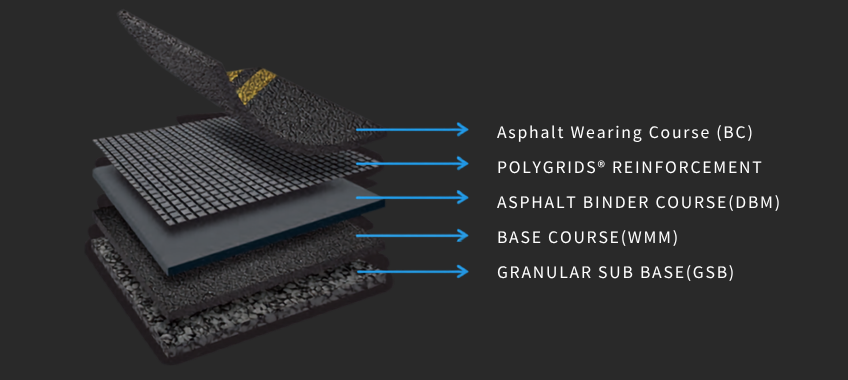
The polypropylene nonwoven sits beneath the fiberglass grid, reinforcing the binder course and blocking moisture from the aggregate layer, while the grid above resists stress-related cracking.
| Material | Fiberglass grid bonded to polypropylene nonwoven geotextile |
| Function | Reinforcement + moisture barrier at binder course level |
| Tack Coat Rate — GCM (approx.) | 0.9 – 1.3 kg/m² |
| Tack Coat Rate — GC (approx.) | 1.2 – 1.8 kg/m² |
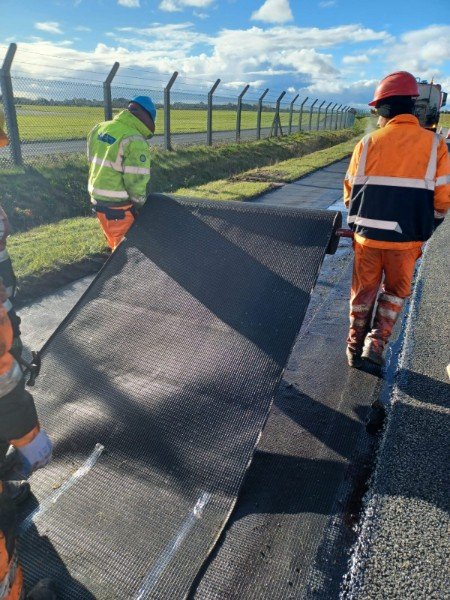
| Installation | Applied directly onto tack coat |
| Available Grades | PT525, PT1025, PT2025 — in GC and GCM configurations |
| Tensile Strength (approx.) | 50/50 kN/m – 200/200 kN/m, grade dependent |
| Certification | CE registered (European Union) |
Tack coat rates are drawn from our installation guide; tensile strength is an approximate industry-typical range — request the grade-specific datasheet for exact values.
Polygrids® provides effective reinforcement to help reduce premature pavement deterioration and extend pavement service life.
Manufactured on imported German machinery to international standards.
Cost-effective without compromising on quality.
Large volume capability for major infrastructure projects.
Expert assistance for installation and project planning.
On-time delivery across Gujarat and all India.
Tailored to specific infrastructure requirements.
Polygrids® PT GC/GCM TDS documents, grouped by coating type. Choose your grade below.
Mechanical or manual install
Self-AdhesiveFaster, tack-free installation
GeocompositeReinforcement + waterproofing
Heavy-duty moisture barrier
Looking for Polygrids® GC or GCM for your next project? Contact us for product specifications, pricing, technical support, and bulk inquiries.